
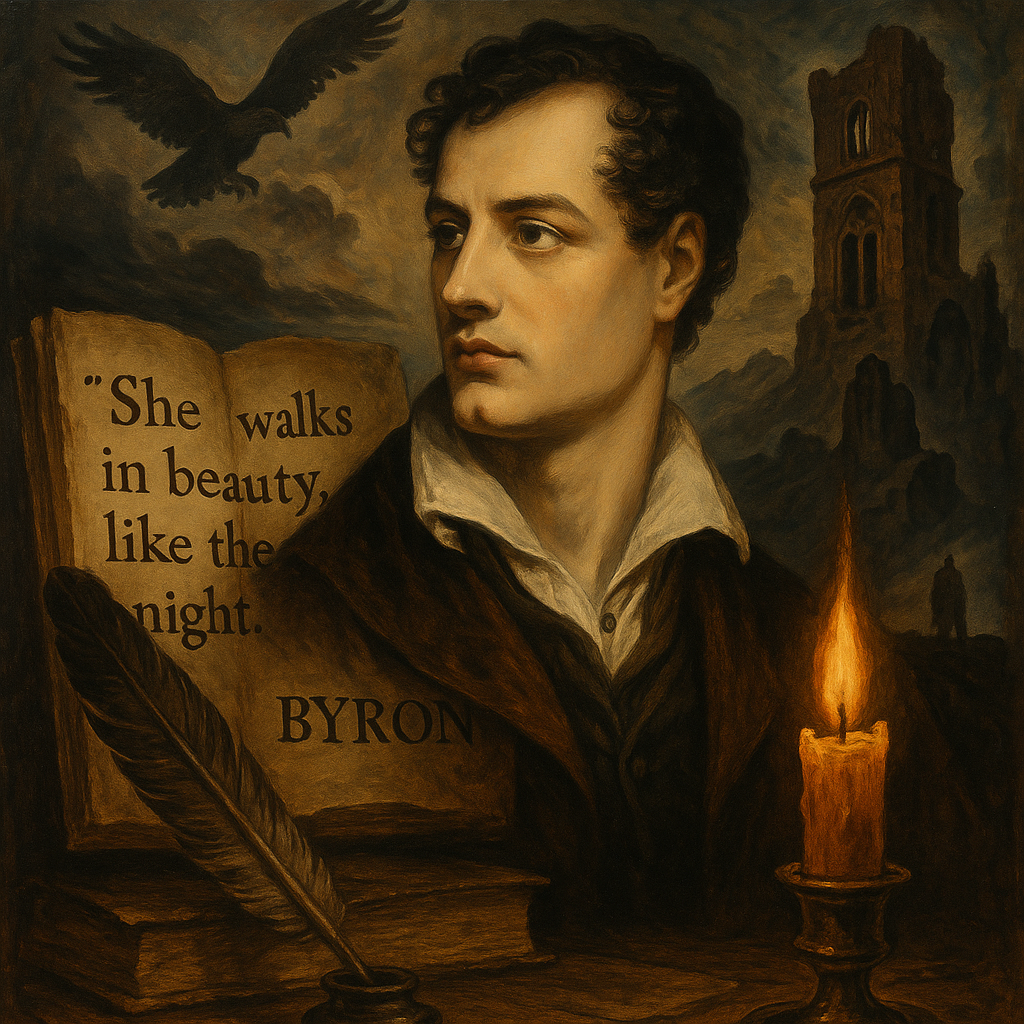
In the vibrant tapestry of literature, few figures shine as brightly as George Gordon Byron, better known to the world as Lord Byron. A poet, a playwright, and an irresistible figure of the early 19th century, Byron’s life was marked by contradictions—intense passion and profound melancholy, profound genius and reckless abandon. He didn’t just write poetry; he lived it, a whirlwind of emotions and experiences that would go on to shape not only his own legacy but also the very landscape of English literature.
Born on January 22, 1788, in London, Lord Byron’s early life was marked by both privilege and tragedy. The son of a British Army officer and a mother from the aristocracy, Byron was introduced to a life of both comfort and expectation. However, his childhood was fraught with upheaval; his father abandoned the family when Byron was just three years old, leaving his mother to raise him in relative poverty. This difficult beginning would seep into his later works, where themes of abandonment and longing often echoed.
Byron’s education at Harrow School and later at Trinity College, Cambridge, cultivated his natural talent for writing and oratory. By the time he published “Childe Harold’s Pilgrimage” in 1812, Byron had already begun to solidify his reputation as a literary star. His life was a series of epic adventures, filled with romantic liaisons, political fervor, and a public persona that captivated his contemporaries. The stories of his many affairs, particularly with notable figures such as Lady Caroline Lamb and Ada Lovelace, crafted the image of a poet who was as much a part of the social elite as he was a tormented artist.
Yet, Byron’s life was not simply about romantic escapades. His political activism, especially in support of the Greek War of Independence, showcased a deep passion for justice that transcended personal pleasure. This commitment to ideals of freedom and heroism is reflected in many of his quotes, where themes of love, loss, and the human condition are intertwined.
One of Byron’s most famous quotes, “The heart will break, but broken live on,” speaks volumes about his understanding of love’s complexities. It encapsulates the idea that love, while profoundly beautiful, often comes with an underlying pain that leaves us changed. Byron lived this truth, frequently oscillating between deep affection and profound sorrow. His poetry is laden with the weight of lost love and the yearning for connection, reflecting a life where joy and heartache coexisted in a delicate balance.
Another insightful quote from Byron, “I was always a strange mixture of the two,” reveals his awareness of his dual nature. This sentiment resonates deeply, as it reflects the essence of being human—complex, multifaceted, and often at odds with oneself. Byron embraced his contradictions, which made him relatable and timeless. His ability to articulate such profound feelings has left readers pondering their own experiences of love, loss, and identity.
Byron’s exploration of the self is not just confined to his own experiences; it extends to the universal struggles of humanity. His quote, “The brow may be a little clouded with care, but the heart is still light,” inspires resilience amidst adversity. It serves as a reminder that while life may present its challenges, our spirit can still find joy and lightness if we allow ourselves to embrace it.
Byron’s influence on literature cannot be overstated. He is often credited as a precursor to the Romantic movement, paving the way for poets and writers who sought to explore the depths of human emotion and the beauty of nature. His characters, often embodying the “Byronic hero,” became archetypes for many future literary figures, reflecting the complexities of the human soul.
Moreover, Byron’s works continue to resonate with readers today. His themes of love, rebellion, and introspection echo in modern literature and art, proving that his voice is indeed timeless. Not only did he challenge societal norms of his time, but he also inspired countless individuals to embrace their own passions and contradictions.
In conclusion, the life of Lord Byron is a rich narrative of passion, heartbreak, and artistic brilliance. His quotes serve as windows into his soul, revealing the complexities of love and the human experience. Byron’s legacy endures, not just through his poetry but through the inspiration he provides to each generation that discovers his work. As we reflect on his life and words, we are reminded of the beauty and pain inherent in the pursuit of love and truth, urging us to live boldly and authentically, much like Byron himself.