
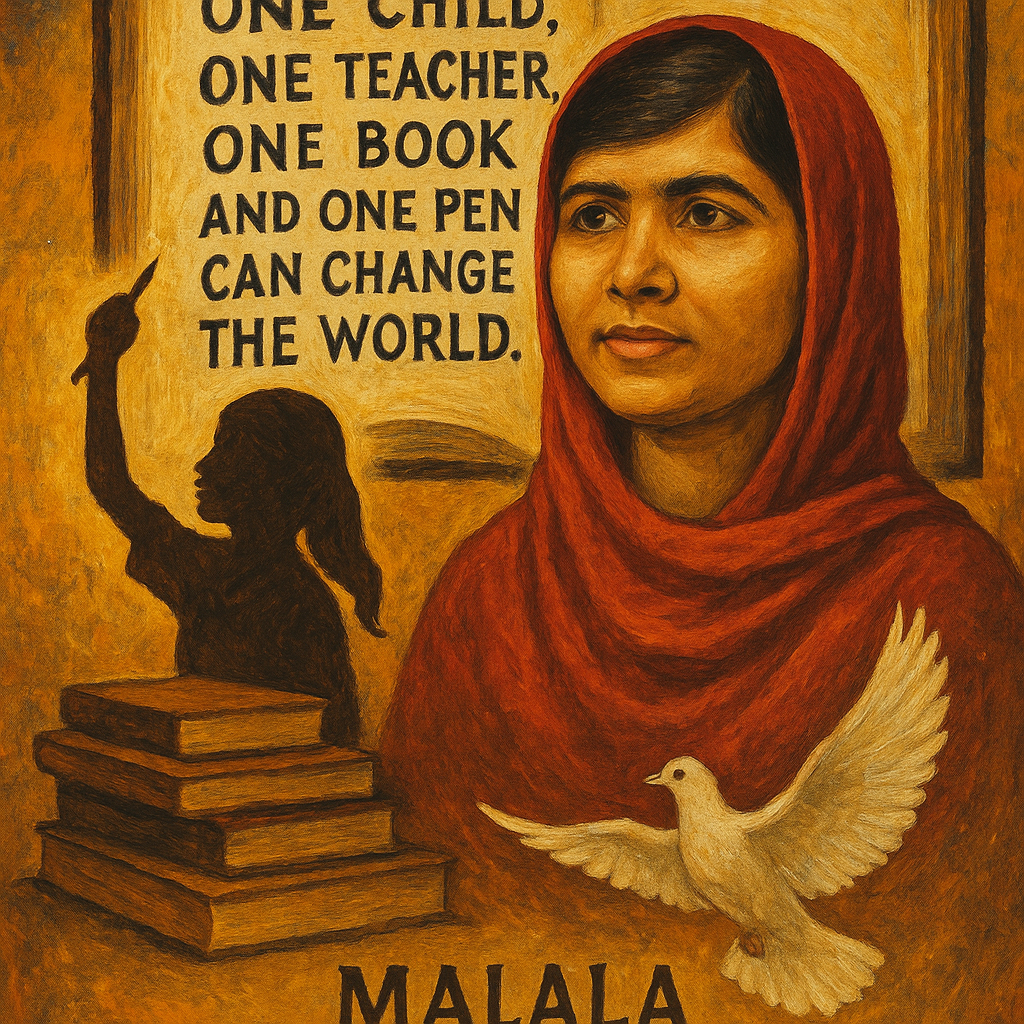
In a world where words often fall flat against the weight of oppression, Malala Yousafzai’s voice emerges as a powerful anthem of courage and resilience. Born on July 12, 1997, in Mingora, Pakistan, Malala’s journey from a young girl advocating for her right to an education to becoming the youngest Nobel Prize laureate is nothing short of extraordinary. Her life story resonates with those who dare to dream, and her quotes challenge us to reflect on the importance of education, empowerment, and human rights.
Malala was raised in the picturesque Swat Valley, where her father, Ziauddin Yousafzai, operated a school. His commitment to education laid the foundation for her own educational aspirations. From a young age, Malala exhibited a fierce desire to learn and a profound belief in the transformative power of education. However, the Taliban’s rise in her region brought a cruel halt to her dreams. In 2009, at the tender age of 11, Malala began writing a blog for the BBC Urdu service under a pseudonym, detailing the harrowing experiences of girls denied education.
Her words were a clarion call, a beacon of hope in a darkened world. Yet, the very act of speaking out drew the attention of the Taliban, culminating in a horrific assassination attempt on her life in October 2012. Malala survived against all odds, and rather than retreating into silence, she emerged with an even stronger resolve. This pivotal moment in her life transformed her into a symbol of resistance, not just for girls in Pakistan but for all those who believe in the right to education.
Malala’s quotes encapsulate her philosophy and serve as guiding principles for those who are inspired by her journey. One of her most famous quotes, “One child, one teacher, one pen, and one book can change the world,” embodies her unwavering belief in the power of education. This statement reflects not just her personal experiences but also a universal truth: that education is the bedrock upon which societies are built.
When she speaks, her words are imbued with a sense of urgency and hope. They remind us that each individual has the potential to spark change. Malala’s insistence that education can challenge societal norms and empower the marginalized is particularly poignant in a world where access to education remains a privilege for many. By sharing her story, she encourages us to recognize our own capacity for influence.
Another poignant quote from Malala is, “I raise up my voice—not so that I can shout, but so that those without a voice can be heard.” This quote reflects her deep empathy and aligns with her commitment to activism. It underscores her understanding of privilege and responsibility; she uses her platform to amplify the voices of those who are often silenced. In a society rife with inequality, her call to action resonates powerfully, reminding us that advocacy is not just about speaking out but about fostering a community where everyone is heard and valued.
The legacy of Malala Yousafzai extends far beyond her accolades; it resides in the hearts of countless individuals inspired by her courage. In 2014, she became the youngest recipient of the Nobel Peace Prize, a recognition that solidified her status as a global advocate for education. Her story has transcended borders, inspiring campaigns and movements focused on educational equality around the world.
Through the Malala Fund, established in 2013, she continues to advocate for girls’ education, focusing on regions where access remains a challenge. Her relentless pursuit of equality exemplifies how one voice can indeed change the world. By championing the cause of education, Malala is not just leaving a legacy; she is igniting a movement that encourages future generations to pursue knowledge and challenge injustices.
In a world often marked by despair, Malala Yousafzai’s life and words serve as a reminder of the strength of the human spirit. Her journey shows us that courage can emerge in the face of adversity, and hope can thrive even in the darkest of places.
As we reflect on Malala Yousafzai’s life and the meanings behind her quotes, we are invited to consider our own paths toward empowerment and advocacy. Her story is a testament to the transformative power of education and the importance of standing up for the rights of others. Let us carry forward her message: that every child deserves the chance to learn, to speak, and to be heard. In doing so, we honor Malala’s legacy and become part of a larger story of resilience, hope, and change. So, let’s pick up our pens, raise our voices, and strive to make a difference—one word, one action at a time.