
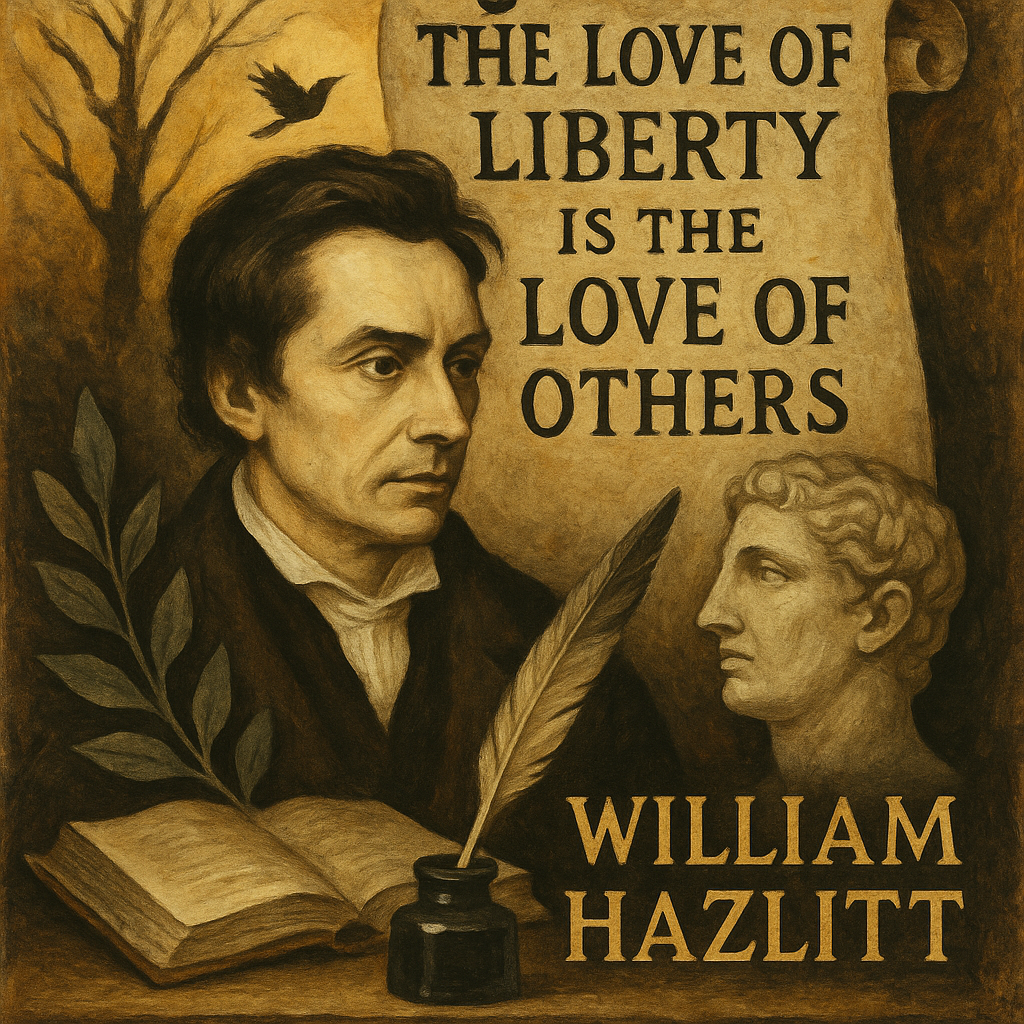
William Hazlitt, a name that may not echo through the halls of literary fame as loudly as some of his contemporaries, was a man of profound insight and emotion. His words have a way of capturing the human experience, making us reflect upon our desires, our failings, and, most importantly, our individuality. In this cozy exploration, we will journey through the life of Hazlitt, delve into the meanings behind some of his most memorable quotes, and contemplate the lasting legacy he has left in the world of literature.
Born on April 10, 1778, in Maidstone, England, William Hazlitt was destined for a life intertwined with the arts. His father, a Unitarian minister, and his mother, a woman of quiet strength and intellect, imbued in him a love for literature that would blossom throughout his life. After a somewhat lackluster education at home and a brief stint at a boarding school, Hazlitt emerged as a promising young thinker, though not without his share of struggles.
In his early twenties, Hazlitt took a bold step, choosing to pursue painting instead of following in his father’s clerical footsteps. However, art was not to be his ultimate calling; it was in the realm of writing that he truly excelled. Hazlitt became an accomplished essayist, critic, and philosopher, known for his keen observations on human nature and society.
His writings reflected his passion and his tumultuous relationships, particularly with fellow thinkers like Samuel Taylor Coleridge and William Wordsworth. Hazlitt loved deeply and felt profoundly, and his personal experiences often colored his prose. By the time of his death in 1830, his contributions to literature had established him as a formidable voice of the Romantic era, yet his influence has only grown with time.
William Hazlitt’s quotes are a treasure trove of wisdom that resonates with readers even today. One of his most famous quotes, “The only vice is complacency,” encapsulates his belief that the greatest danger lies in a lack of self-awareness. This quote speaks to the essence of Hazlitt’s philosophy: the understanding that personal growth requires acknowledging our flaws and striving for change. It encourages us to avoid the trap of self-satisfaction, reminding us that there is always room for improvement in our lives.
Another powerful quote from Hazlitt, “We are always doing something for the sake of doing it,” reflects the complexity of human motivation. Here, he urges us to act not merely out of habit or obligation, but with purpose and passion. This assertion is particularly poignant in our modern world, where distractions abound, and genuine engagement can often be sidelined. Hazlitt’s words serve as a gentle nudge to pursue activities that ignite our spirit rather than simply fill our time.
The depth of Hazlitt’s understanding of human emotions is encapsulated in his assertion, “There is no such thing as a good writer, only a good rewriter.” This quote speaks volumes about the vulnerability and humility inherent in the creative process. Hazlitt understood that true artistry lies in perseverance and refinement, a lesson that resonates with all who dare to express themselves through writing—or any form of art, for that matter.
Hazlitt’s legacy is a rich tapestry woven from his insights into human nature, his passion for literature, and his unyielding advocacy for individuality. While he may not have achieved the fame of his contemporaries, his influence has quietly permeated the works of many writers who followed. From the introspective essays of Virginia Woolf to the sharp critiques of modern culture by George Orwell, Hazlitt’s voice can be felt echoing through time.
His timeless quotes continue to inspire readers and writers alike, serving as a reminder that the pursuit of truth, beauty, and self-awareness is a lifelong journey. Hazlitt’s ability to articulate the intricacies of human emotion and experience makes his work relevant today, encouraging us to embrace our individuality and reflect on our motivations.
As we reflect on the life and work of William Hazlitt, we find ourselves drawn to his beliefs in the transformative power of literature and self-reflection. In a world that often seeks to define us, Hazlitt nudges us to carve our own paths, challenge complacency, and engage deeply with our passions.
William Hazlitt’s life and words remind us of the beauty of introspection and the importance of authenticity. In a society that often rushes towards conformity, his call to embrace individuality rings louder than ever. Like a warm cup of tea on a chilly afternoon, his quotes invite us to pause, reflect, and engage with the world around us. As we navigate our own paths, let us carry forward Hazlitt’s spirit—a spirit that champions self-discovery, creativity, and the continuous quest for understanding. It is in this journey that we truly live, and in this pursuit, we may find our most authentic selves.