
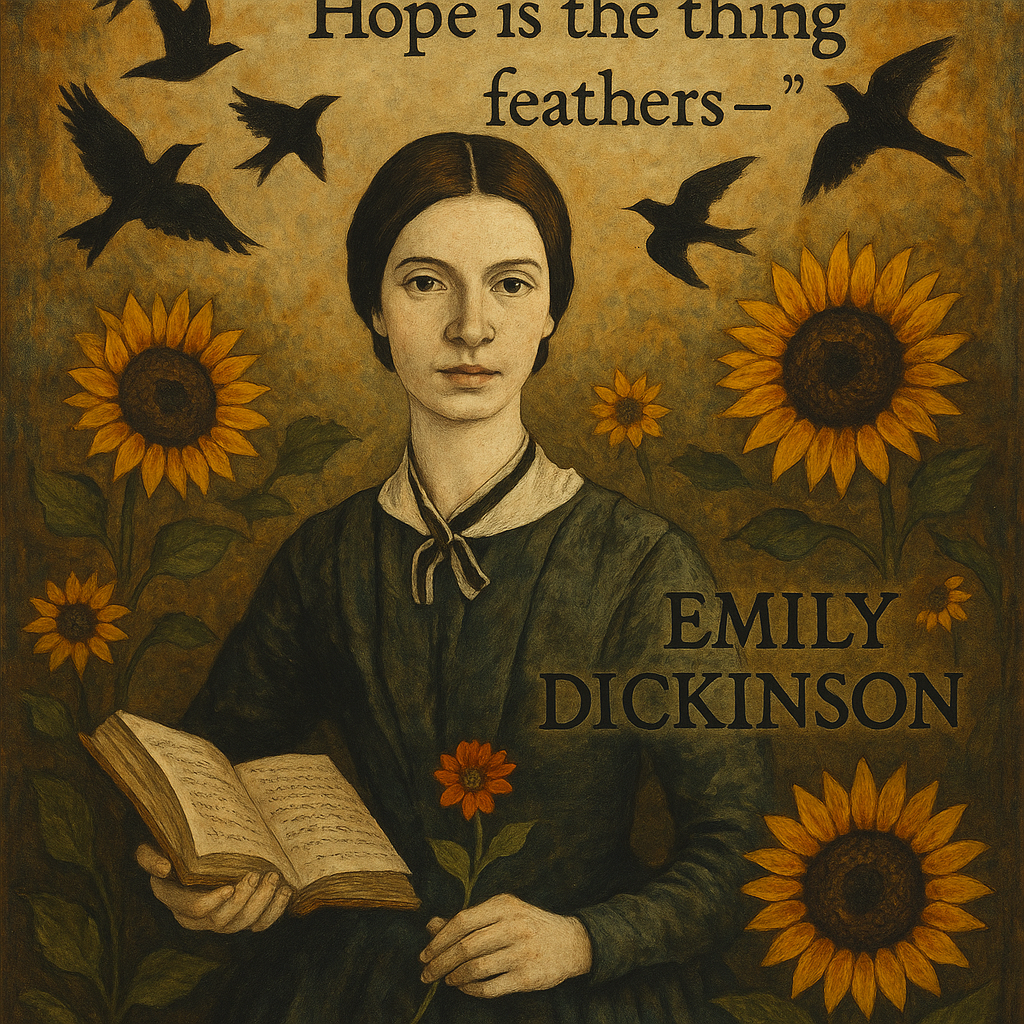
Emily Dickinson, a poet whose words still resonate through the ages, offers us not just an insight into her introspective world but also a glimpse into the human experience itself. An enigmatic figure, Dickinson lived much of her life in the quaint yet isolating town of Amherst, Massachusetts. Despite her reclusive nature and the limited recognition she received during her lifetime, her work continues to inspire and touch countless hearts.
In this blog post, we will explore Emily Dickinson’s vibrant life, the profound meaning behind some of her most quoted lines, and the enduring legacy she has left on literature and culture.
Born on December 10, 1830, Emily Dickinson grew up in a well-to-do family, steeped in the traditions of early American literature and intellectual thought. Her father, Edward Dickinson, served as a prominent lawyer and politician, while her mother, Emily Norcross Dickinson, was a homemaker. The early years of Emily’s life were filled with education and literature, as she attended the Amherst Academy and later the Mount Holyoke Female Seminary. However, it was her time at home that truly shaped her literary voice.
As Dickinson matured, she found herself increasingly withdrawn from society. The confines of her family home became both a sanctuary and a prison from which she would seldom emerge. This self-imposed isolation allowed her to explore her inner thoughts, crafting over 1,800 poems—many of which delve into themes of love, death, nature, and the human condition. Though she corresponded with friends and family, her avoidance of the public eye would lead to a limited readership during her lifetime.
The complexity of Dickinson’s life is mirrored in her poetry, where her keen observations often reflect her personal struggles with loneliness and the search for meaning. One of her most famous quotes, “Hope is the thing with feathers / That perches in the soul,” encapsulates her ability to find beauty and light even in her darkest moments.
Emily Dickinson’s quotes are not merely eloquent phrases; they are windows into her soul. The simplicity and profundity of her words often hold layers of meaning. Take, for instance, her reflection on hope. In the quote mentioned earlier, she personifies hope as a bird, suggesting that it is a delicate yet resilient entity. This metaphor resonates deeply with anyone who has faced adversity, reminding us that hope can be ever-present, even when life feels heavy.
Another poignant quote, “Because I could not stop for Death – He kindly stopped for me,” illustrates Dickinson’s unique perspective on mortality. Rather than viewing death as something to fear, she presents it as a gentle companion. This acceptance is both haunting and comforting, encouraging readers to consider their own relationship with life and death. In Dickinson’s world, death is not an end but a transition—a theme that threads through much of her work.
The accessibility of her quotes, combined with their rich imagery, ensures that Dickinson’s voice remains relevant. Her exploration of themes such as identity, love, and existence continues to captivate readers, inviting them to reflect on their own lives and aspirations. This is the beauty of Emily Dickinson: she speaks to our universal experiences, bridging the gap between the 19th century and today.
Despite her reclusive nature, Emily Dickinson’s influence on literature is undeniable. After her death in 1886, her sister Lavinia discovered Dickinson’s trove of poems and worked tirelessly to share her sister’s legacy with the world. The posthumous publication of her work in the late 19th and early 20th centuries sparked interest that has only grown over time.
Dickinson’s innovative use of form and punctuation, her unique use of slant rhyme, and her deep philosophical insights have earned her a revered place in the pantheon of American literature. Contemporary poets and writers often cite her as a significant influence, and her work has been studied in schools and universities worldwide.
Her legacy goes beyond the realm of poetry; it challenges societal norms surrounding gender and creativity. Dickinson defied the expectations of her time, choosing to express her individuality through her art rather than conforming to the prescribed roles of women. In an era when women’s voices were often silenced, she carved out her space, leaving behind a trail of inspiration for future generations.
Emily Dickinson’s life and work remind us that we all have the capacity for introspection and creativity. Her quotes, rich with emotion and insight, serve as powerful reminders of the beauty and complexity of the human experience.
As we navigate our own lives, let us take a page from Dickinson’s book—embracing solitude when needed, finding hope in unexpected places, and accepting the inevitability of change. In her words, we are invited to reflect on our lives: “There is no Frigate like a Book / To take us Lands away.” So let us embark on our own journeys, inspired by her legacy, ever seeking the beauty in the ordinary and the magic in our everyday lives.