
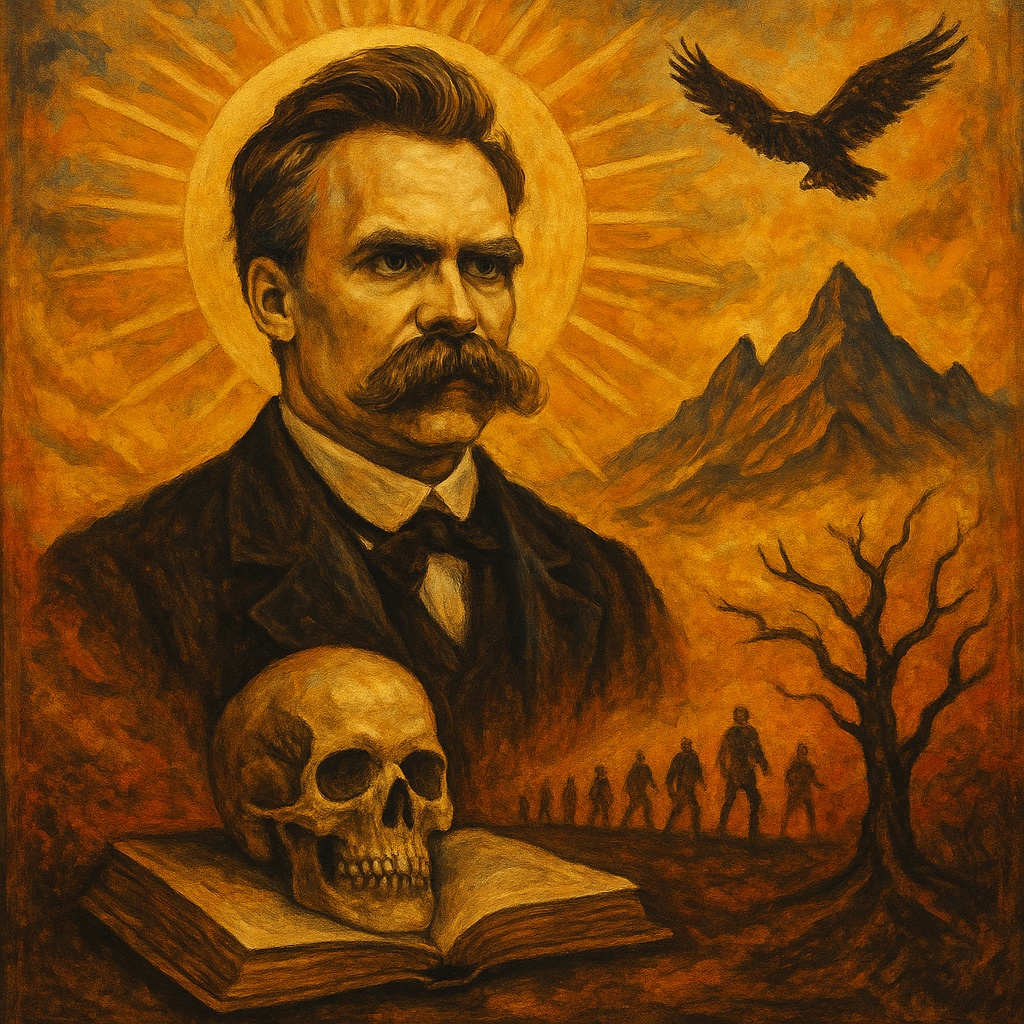
Friedrich Nietzsche—a name that, for many, evokes a whirlwind of intellectual exploration, philosophical rebellion, and profound existential inquiry. Born on October 15, 1844, in Röcken, Germany, Nietzsche’s life was anything but ordinary. He was a thinker who meandered through the complex pathways of human existence, questioning morality, religion, and the very essence of being. His quotes, steeped in both insight and controversy, continue to resonate in our modern world, inviting reflection and challenging conventions.
In this exploration of Nietzsche’s life and the meaning behind some of his most powerful quotes, we seek to understand the man whose thoughts have influenced generations and whose legacy remains vital today.
Nietzsche’s early life was marked by tragedy, losing his father, a Lutheran pastor, at just five years old. This loss deeply impacted him, perhaps igniting a questioning of faith and tradition that would echo throughout his writings. He was a brilliant student, earning a scholarship to the University of Bonn, and later transferring to the University of Leipzig, where he immersed himself in classical philology. However, his academic career was cut short due to health issues, leading him to resign from his position at the University of Basel in 1879.
During his life, Nietzsche grappled with various philosophical themes, drawing from his extensive readings and personal experiences. His notable works, including “Thus Spoke Zarathustra,” “Beyond Good and Evil,” and “The Birth of Tragedy,” reflect his revolutionary ideas about the “will to power” and the concept of the Übermensch or “Overman.” This vision of a self-overcoming individual speaks to the need for personal growth and the pursuit of authenticity in a world often riddled with societal expectations.
Despite his brilliance, Nietzsche’s later years were marred by mental illness, leading to his eventual collapse in 1889. He spent the last decade of his life under the care of his mother and sister, unable to continue his philosophical work. Although his life was filled with struggle, it was undeniably rich in thought and creativity, paving the way for generations of thinkers to follow.
Nietzsche’s quotes resonate like echoes of an ancient wisdom, each one a portal into his intricate philosophy. One of his most famous aphorisms, “What does not kill me makes me stronger,” offers a glimpse into his exploration of suffering and resilience. This quote encapsulates Nietzsche’s belief in the transformative power of adversity. It suggests that trials and tribulations are not merely obstacles; they are vital components of personal growth and self-discovery. In today’s world, this idea encourages us to embrace challenges as opportunities for development rather than signs of weakness.
Another profound quote by Nietzsche is, “He who has a why to live can bear almost any how.” This statement underscores the importance of purpose in navigating life’s difficulties. For Nietzsche, a life devoid of meaning is one fraught with despair. By instilling our lives with purpose—whether through relationships, passions, or beliefs—we can endure even the harshest realities. His insights remind us that finding our personal “why” is essential for resilience and fulfillment.
In examining Nietzsche’s quotes, we also encounter the notion of the eternal recurrence, where he asks us to consider: “Would you be willing to live your life over and over again, in exactly the same way?” This thought experiment challenges us to evaluate our choices and direction. It asks us to live authentically, aware that each decision shapes not just our future but our very existence. Nietzsche’s call to reflect on the significance of our actions pushes us toward a more intentional life.
Nietzsche’s influence extends far beyond the realm of philosophy. His ideas have permeated literature, psychology, art, and politics, shaping the contours of modern existential thought. His challenge to traditional morality and religion resonates with those who seek to navigate a world increasingly characterized by uncertainty and complexity. Thinkers like Martin Heidegger, Sigmund Freud, and Jean-Paul Sartre have drawn upon Nietzsche’s work, weaving his ideas into their own philosophies.
Despite the challenges he faced during his life, Nietzsche’s legacy is one of courage and authenticity. He pushed boundaries, prompting society to question what it means to be human in a rapidly changing world. His call for individuals to embrace their unique paths and reject conformity is perhaps more vital now than ever as we navigate the complexities of contemporary life.
As we reflect on the life of Friedrich Nietzsche and the meaning behind his quotes, we are reminded of the power of introspection and the importance of questioning the status quo. Nietzsche’s journey through suffering, brilliance, and eventual decline teaches us that life is both beautiful and tragic—a tapestry woven with threads of joy, pain, and insight. His legacy challenges us to live boldly, to confront our limitations, and to find strength in our vulnerabilities.
In the spirit of Nietzsche, let us embrace the notion that our struggles can indeed forge our strength. Let his words inspire us to seek purpose, reflect on our lives’ meaning, and dare to live authentically. After all, as Nietzsche himself might say, it is through the pursuit of our unique truths that we can truly thrive.