
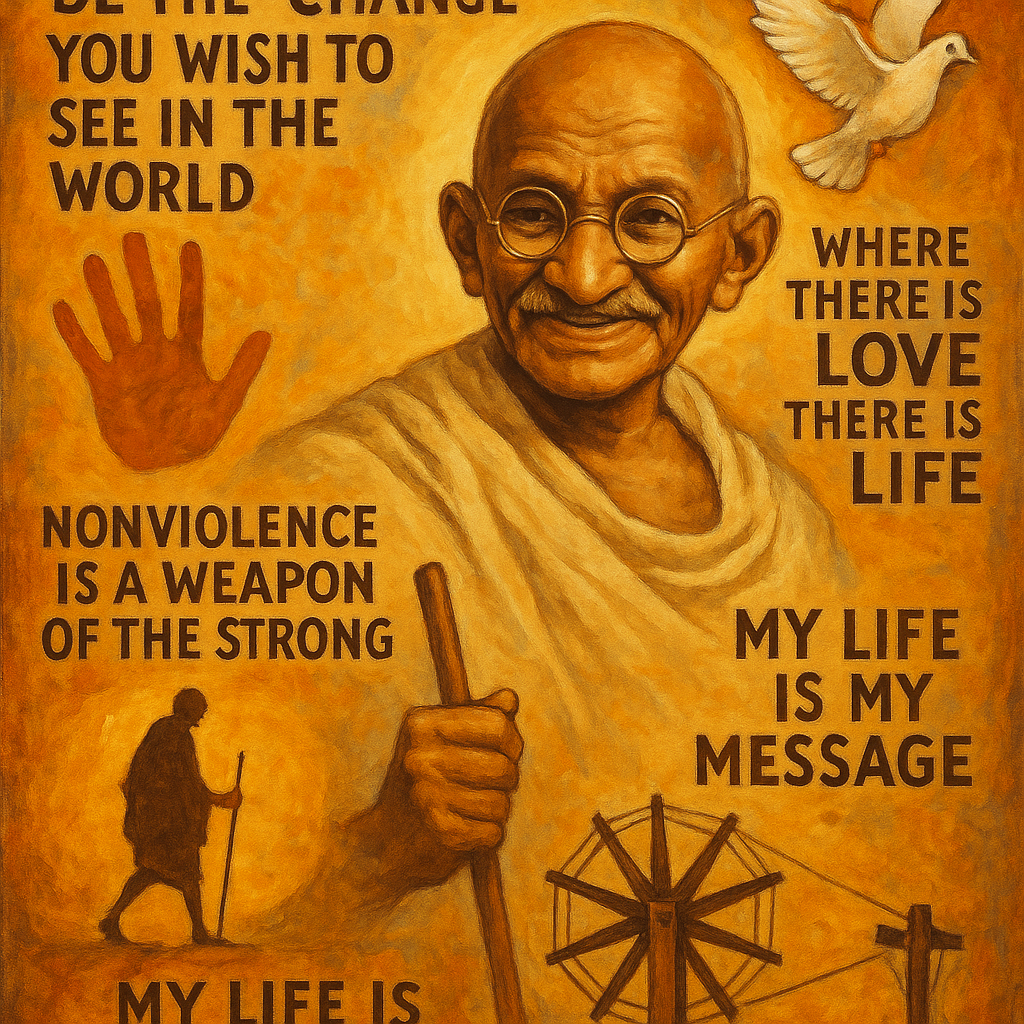
Mahatma Gandhi, a name synonymous with peaceful resistance and transformative leadership, stands as one of history’s most revered figures. As the architect of India’s freedom struggle against British colonial rule, his philosophies transcended borders and inspired countless movements for civil rights and freedom worldwide. This blog post delves into Gandhi’s remarkable life, the profound meaning behind his quotes, and the enduring legacy he left for future generations.
Born on October 2, 1869, in Porbandar, India, Mohandas Karamchand Gandhi—later known as Mahatma, meaning “great soul”—grew up in a modest family grounded in the values of truth and non-violence. His early education in law at the Inner Temple in London laid the groundwork for his later activism. However, it was during his time in South Africa that Gandhi first employed his principles of non-violent resistance, or Satyagraha, against racial discrimination.
Gandhi’s return to India in 1915 marked the beginning of a significant chapter in not only his life but also the nation’s history. As he assumed leadership of the Indian National Congress, he orchestrated multiple campaigns against British rule, advocating for self-rule and civil rights through peaceful protests, strikes, and boycotts. His philosophy of non-violence became a guiding light for millions, challenging the notion that violence was a necessary means to achieve freedom.
Despite facing imprisonment, violence, and personal loss, Gandhi remained steadfast in his beliefs. His commitment to truth and non-violence ultimately led to India achieving independence on August 15, 1947. Tragically, this victory came just months before Gandhi’s assassination on January 30, 1948, at the hands of a religious fanatic. Yet, his teachings and philosophies continue to resonate far beyond his lifetime.
Gandhi was not only a pivotal figure in history but also a profound thinker whose quotes encapsulate his insights into life, society, and human nature. One of his most famous quotes, “Be the change you wish to see in the world,” serves as a powerful reminder of personal responsibility in the quest for societal transformation. This quote emphasizes that individuals must embody the values they wish to see manifested in the world. It challenges us to take initiative rather than waiting for external circumstances to change.
Another notable quote, “An eye for an eye only ends up making the whole world blind,” reflects Gandhi’s deep understanding of the cyclical nature of violence. In advocating for non-violence, he encouraged individuals to break this vicious cycle of retaliation and instead promote understanding and empathy. His perspective insists that enduring peace can only be achieved through compassion, rather than revenge.
Gandhi’s words continue to inspire movements for justice and equality around the world. His teachings on non-violent protest influenced leaders such as Martin Luther King Jr. and Nelson Mandela, who carried forth the torch of civil rights in their respective struggles. By analyzing Gandhi’s quotes, we recognize the depth of wisdom embedded in his advocacy for peace and justice.
The legacy of Mahatma Gandhi extends far beyond the confines of Indian independence. His approach to social change remains a blueprint for activists and leaders across the globe. Gandhi’s influence can be seen in various movements that advocate for civil rights, environmental justice, and social equity. His methodologies have been integrated into academic curricula and continue to inspire countless individuals to fight for what is right through non-violent means.
The Gandhi Global Solar Yatra, which promotes sustainable energy, and the various peace organizations that celebrate his philosophy of non-violence, testify to his lasting impact. Gandhi’s teachings on simplicity and self-sufficiency have encouraged modern movements towards sustainable living.
Moreover, Gandhi’s birthday, celebrated as the International Day of Non-Violence, serves as a reminder of the power of peaceful resistance in the face of injustice. As we reflect on Gandhi’s life and quotes, we find relevant lessons applicable to contemporary issues, such as climate change, inequality, and human rights.
Mahatma Gandhi’s life and teachings are a testament to the strength of the human spirit and the power of non-violence. His quotes encapsulate a profound philosophy that urges us to seek change within ourselves before demanding it from the world. As we navigate the complexities of modern society, Gandhi’s message of peace, empathy, and personal responsibility remains ever relevant. In his own words, “The best way to find yourself is to lose yourself in the service of others.” Let us strive to honor his legacy by embodying these principles in our daily lives and working towards a more just and compassionate world.