
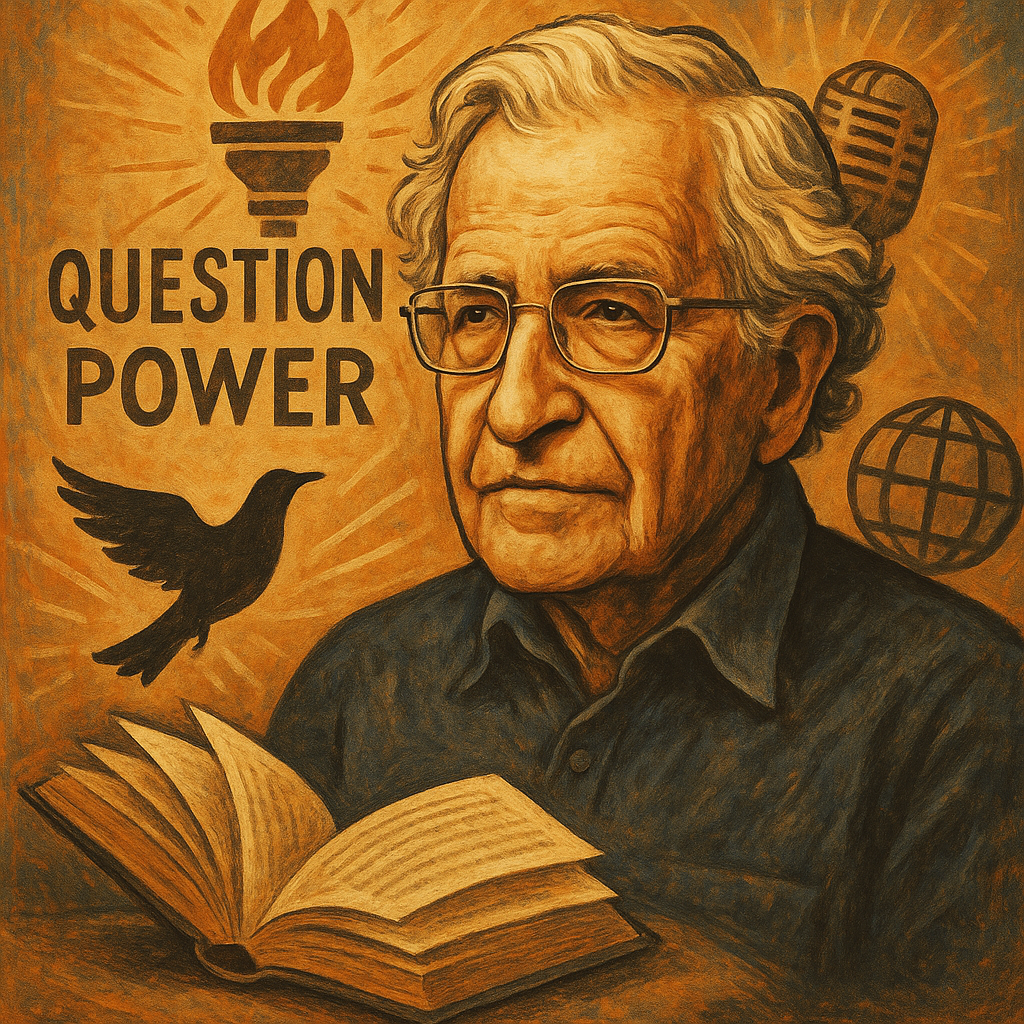
When we think of intellectual giants, few names resonate as profoundly as Noam Chomsky. A towering figure in linguistics, philosophy, and political activism, Chomsky has not only altered the landscape of how we understand language but has also provided a clarion call for social justice and critical thought. His journey, marked by an insatiable curiosity and a commitment to truth, continues to inspire generations. As we delve into the life of Noam Chomsky, we will explore the essence of his insightful quotes and the lasting legacy he leaves behind.
Born on December 7, 1928, in Philadelphia, Pennsylvania, Noam Chomsky grew up in a family that valued education and intellectual inquiry. His father, a Hebrew teacher, and his mother, a schoolteacher, nurtured his early interest in language and philosophy. Chomsky’s academic prowess became evident at a young age, and he pursued his studies at the University of Pennsylvania, where he would eventually earn a Ph.D. in linguistics.
Chomsky’s groundbreaking work on transformational-generative grammar in the 1950s revolutionized the field of linguistics. He challenged the prevailing behaviorist views of language acquisition, proposing instead that humans possess an innate ability to understand the structure of language. His assertion that language is a uniquely human trait laid the groundwork for modern cognitive science, influencing not just linguists but also psychologists and philosophers alike.
However, Chomsky’s influence extends far beyond the walls of academia. In the 1960s, he began to speak out against U.S. foreign policy, particularly regarding the Vietnam War. His outspoken critiques in works such as “Manufacturing Consent” and “Hegemony or Survival” expose the manipulation of public opinion and the intricate ties between media and power. Chomsky’s transformation from a linguist to an activist highlights his unwavering commitment to social equity and the pursuit of truth, solidifying his role as a moral compass in turbulent times.
Chomsky’s quotes encapsulate his profound insights on language, politics, and human nature. One of his most famous assertions is, “The responsibility of intellectuals is to speak the truth and expose lies.” This powerful statement not only reflects Chomsky’s own path but also serves as a call to arms for all who dare to challenge the status quo. It underscores the essential role that intellectuals and thinkers have in society, urging them to prioritize truth over convenience.
In another poignant remark, he states, “It is the responsibility of intellectuals to speak the truth and expose lies.” This quote resonates deeply, particularly in an era where misinformation can spread rapidly. Chomsky reminds us that it is not enough to simply know the truth; we must also actively seek to disseminate it, empowering others in the process.
Chomsky’s quotes often carry a sense of urgency, urging us to reflect on our complicity in societal structures. As he famously said, “If we don’t believe in freedom of expression for people we despise, we don’t believe in it at all.” This statement pushes us to confront our biases and understand that true freedom of expression must be inclusive, even of ideas that challenge our own beliefs.
Chomsky’s legacy is multifaceted, weaving through various domains of thought and activism. As a linguist, he reshaped our understanding of language and cognition. As a political activist, he became a voice for the voiceless, advocating for a more equitable world. His influence can be seen in the works of countless scholars, activists, and thinkers who draw inspiration from his ideas and courage.
Moreover, Chomsky’s dedication to education and the dissemination of knowledge has fostered an entire generation of critical thinkers. The way he intertwines theory with practical activism serves as a roadmap for those wishing to effect change in their communities. His continued engagement with contemporary issues reminds us that the pursuit of truth is an ongoing journey, requiring vigilance and courage.
As we reflect on the life of Noam Chomsky, we are reminded that the pursuit of knowledge and justice is a noble path. His insightful quotes challenge us to think critically, speak truthfully, and take action against injustice. In the words of Chomsky, “The general population doesn’t know what’s happening, and it doesn’t even know that it doesn’t know.” In this age of information overload, let us commit ourselves to being informed, to questioning, and most importantly, to holding ourselves accountable.
Through his life and work, Noam Chomsky teaches us that every voice matters and that the pursuit of knowledge is a collective responsibility. May we carry his legacy forward, embracing our role as informed citizens and advocates for truth in our own lives.