
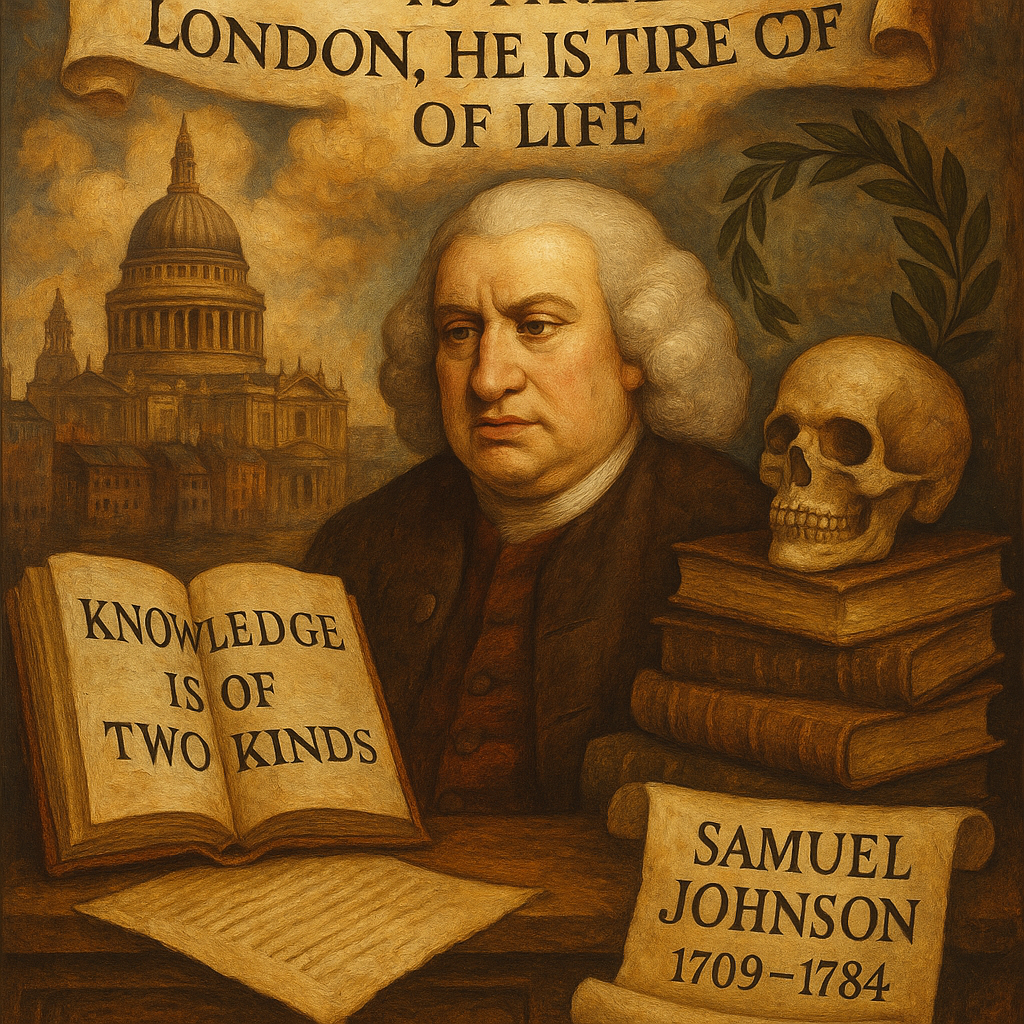
Samuel Johnson, often regarded as one of the most significant figures in English literature, was a man of profound thought and remarkable depth. Born on September 18, 1709, in Litchfield, England, Johnson’s life was a tapestry of triumph over adversity. His journey through the intricacies of 18th-century society shaped not only his own character but also left an indelible mark on the literary world. In this cozy exploration, we will delve into Johnson’s life, the meanings behind some of his most poignant quotes, and the lasting influence of his legacy.
Samuel Johnson’s life was anything but ordinary. The son of a bookseller, he faced hardships early on, including the loss of his father and financial instability. A struggle with poverty and ill health plagued him throughout his youth, yet these challenges could not stifle his intellectual curiosity. Johnson attended Pembroke College at Oxford but left after only a year due to financial constraints. Despite this setback, his voracious appetite for knowledge led him to become a self-taught scholar.
As a writer, Johnson’s contributions were manifold. He is perhaps best remembered for his definitive dictionary, “A Dictionary of the English Language,” published in 1755. This monumental work not only standardized English but also provided insights into the language’s usage and evolution. Johnson’s keen sense of observation and his ability to articulate complex ideas in accessible language made him a beloved figure among readers and writers alike.
In addition to his dictionary, Johnson penned essays, poems, and biographies, including an acclaimed life of his friend and fellow writer, James Boswell. Their friendship is captured beautifully in “The Life of Samuel Johnson,” which remains a cornerstone in the genre of biography. Johnson’s life showcased the importance of resilience and intellectual rigor, qualities that fueled his writing and inspired his contemporaries.
Johnson’s literary output is rich with quotes that resonate even today. One of his most famous sayings, “What we hope ever to do with ease, we must first learn to do with diligence,” encapsulates his belief in the necessity of hard work and perseverance. This quote serves as a reminder that the road to success is paved with effort and commitment. Johnson himself embodied this truth; despite the many obstacles he faced, he dedicated himself to his craft with unwavering determination.
Another powerful quote from Johnson is, “The greatest part of a writer’s time is spent in reading, in order to write; a writer should read deeply and widely.” This statement reveals his understanding of the writer’s journey as one of constant learning. Johnson believed that to create compelling literature, one must immerse themselves in the wisdom of others. His own reading habits, which included extensive engagement with classical literature and contemporary works, informed his writing style and intellectual outlook.
Moreover, Johnson’s quote, “I am not willing to be made a fool of, and I am not willing to be made a martyr,” reflects his disdain for pretense and the importance he placed on authenticity. In a world often rife with artifice, Johnson advocated for honesty and integrity in both life and literature. This theme permeates his work, showcasing his commitment to capturing the human experience in its rawest form.
Samuel Johnson’s legacy is profound and enduring. His influence can be seen in the works of future generations of writers, from Charles Dickens to modern-day authors. His ability to distill complex thoughts into clear, memorable quotes continues to resonate. Johnson’s insights into human nature and society remain relevant, as they touch on universal themes of struggle, resilience, and the pursuit of knowledge.
His literary contributions laid the groundwork for modern lexicography and critical writing. Johnson’s dictionary not only served as a linguistic reference but also as a cultural artifact that reflected the values and nuances of his time. Furthermore, his essays, packed with wit and wisdom, have inspired countless readers to engage with literature more deeply.
In addition to his written works, Johnson’s character—marked by his warmth, humor, and occasional eccentricity—has endeared him to many. His friendship with Boswell stands as a testament to the human connections that fuel creativity and understanding. The heartfelt conversations between the two men provide insight into Johnson’s thinking and his approach to life, solidifying his place as a literary giant.
Samuel Johnson’s life is a testament to the power of perseverance, curiosity, and authenticity. His quotes serve as guiding lights, encouraging us to approach our endeavors with diligence, seek knowledge through reading, and remain true to ourselves. As we navigate our own journeys, we can look to Johnson’s legacy for inspiration, embracing the complexities of our experiences while striving to leave our mark on the world.
In the end, Samuel Johnson reminds us that literature is not merely an escape but a reflection of life itself—a journey worth undertaking with passion and purpose.