
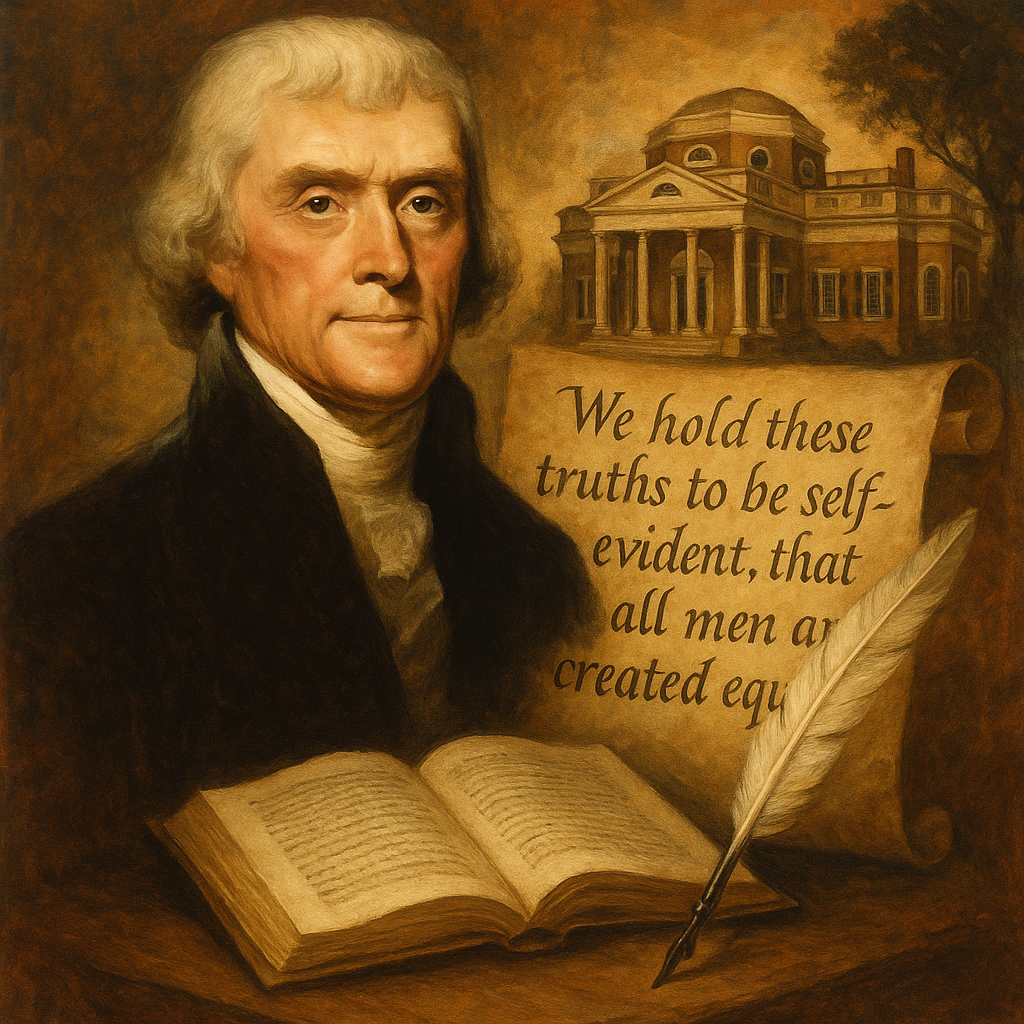
Thomas Jefferson stands as one of the most significant figures in American history. As the principal author of the Declaration of Independence, the third President of the United States, and a visionary leader, Jefferson’s contributions shaped the framework of the nation. His words resonate across time, offering insight into democracy, liberty, and human rights. By exploring the life of Thomas Jefferson, the meaning behind his quotes, and his enduring legacy, we can better appreciate the profound influence he has had on the world.
Born on April 13, 1743, in colonial Virginia, Thomas Jefferson was the third of ten children in a well-to-do plantation family. His father, Peter Jefferson, was a planter and surveyor, which afforded Thomas an education that would set the foundation for his intellectual pursuits. Jefferson studied at the College of William & Mary, where he developed a passion for philosophy, science, and the law.
As a young man, he became actively involved in the burgeoning revolutionary movement. Jefferson’s early political career began in the Virginia House of Burgesses, where he advocated for colonial rights against British tyranny. His most notable contribution came in 1776 when he was appointed to draft the Declaration of Independence. This document eloquently articulated the colonies’ desire for freedom and established the principles of individual rights that continue to inspire people to this day.
Jefferson served as the first Secretary of State under President George Washington and later as Vice President under John Adams. His presidency from 1801 to 1809 was marked by significant achievements, including the Louisiana Purchase and the Lewis and Clark Expedition, both of which expanded the nation’s territory and knowledge. However, Jefferson’s life was not without contradiction; he was a slave owner who struggled with the moral implications of slavery throughout his life. This dichotomy highlights the complex legacy he left behind.
Jefferson’s words often reflect his philosophical beliefs and his vision for America. One of his most famous quotes, “I have sworn upon the altar of God, eternal hostility against every form of tyranny over the mind of man,” embodies his commitment to intellectual freedom and the fight against oppression. This statement reveals his deep-seated belief that free thought is essential for a thriving democracy. Jefferson understood that the strength of a nation lies not only in its laws but also in the minds of its citizens.
Another powerful quote by Jefferson is, “The tree of liberty must be refreshed from time to time with the blood of patriots and tyrants.” This declaration speaks to the necessity of vigilance and sacrifice in the pursuit of liberty. It emphasizes that freedom is not a static condition but a dynamic state that requires constant effort and, at times, sacrifice to maintain.
Jefferson’s quotes are imbued with wisdom that transcends time. “Do you want to know who you are? Don’t ask. Act! Action will delineate and define you.” This quote encourages personal agency and responsibility, suggesting that one’s identity is forged through action rather than passive contemplation. Jefferson’s ability to distill profound concepts into succinct phrases has kept his words alive in the public consciousness and continues to inspire generations.
Thomas Jefferson’s legacy is multifaceted and complex. He is celebrated as a Founding Father who championed the ideals of liberty and democracy, yet he is also critiqued for his ownership of slaves and the contradictions inherent in his beliefs. After his death in 1826, Jefferson’s influence endured, shaping the American political landscape and inspiring movements for freedom and equality.
His vision for education led to the establishment of the University of Virginia, which he designed and founded. Jefferson believed that an informed citizenry was essential for democracy to flourish, and he devoted much of his life to promoting public education. His contributions to architecture, philosophy, and government are also notable, reflecting a Renaissance man whose interests spanned many disciplines.
In modern times, Jefferson’s quotes continue to resonate, offering guidance in times of political and social upheaval. His thoughts on liberty, democracy, and individual rights are often invoked in discussions surrounding civil rights and human freedoms. His legacy endures through the principles he espoused and the foundational role he played in the creation of the United States.
Thomas Jefferson’s life and words remind us of the importance of striving toward a more just and equitable society. His commitment to liberty, education, and the power of ideas continues to inspire and challenge us today. By reflecting on the meaning of his quotes and understanding the complexities of his biography, we can appreciate not only what he accomplished but also the ongoing journey toward realizing the ideals he championed. In the words of Jefferson, ” Enlighten the people generally, and tyranny and oppressions of body and mind will vanish like evil spirits at the dawn of day.” Let us carry this message forward as we navigate our own paths in the pursuit of freedom and justice.